Archive of Truth in Exile Constructs a Social Ecosystem!
A bridge between testimony, digital platforms, and the politics of visibility!
The Archive of Truth in Exile constructs a social ecosystem with the same quiet precision that nature uses to sustain life. Every structure within it: its networks of witness and its pathways of civic memory draws from patterns older than any institution. In this ecosystem, nothing stands alone; each strand depends on another, the way roots, soil, and light conspire to keep a tree upright.
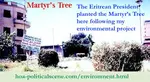
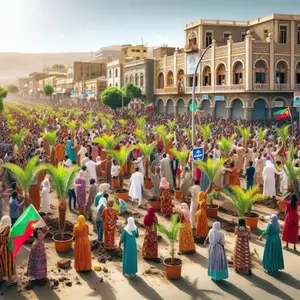
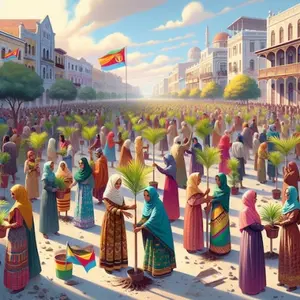
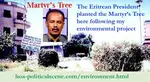
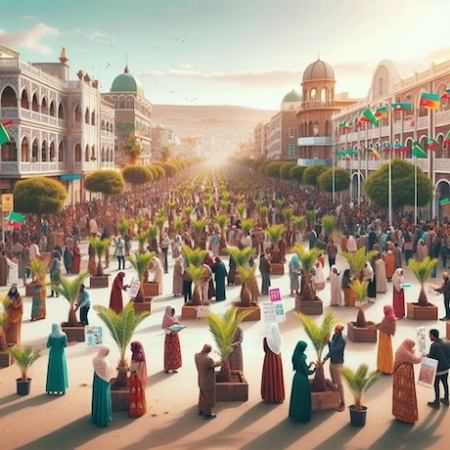 Archive of Truth in Exile Constructs a Social Ecosystem: Visualising Eritrean people planting Eritrean Martyr's trees all over a city. The implementation of my idea was performed by the people everywhere in Eritrea at the same moment during the memorial Martyrs' Day. From this idea the social ecosystem was created and thus became one of the ingredients of the Archive of Truth in Exile.
The Eritrean Martyr's Tree offers the clearest analogue. It is not only a symbol of sacrifice but a living diagram of interdependence: roots that remember, branches that reach, a trunk that carries the weight of collective survival. By invoking this tree, the archive situates itself within a lineage of ecosystems that endure through connection, reciprocity, and the refusal to forget.
This page opens that ecosystem to YOU, the reader revealing its structures, its logic, and the living forces that sustain it.
How Infrastructure Develops an Ecosystem?
The integrated ecosystem I have created from this simple idea and that emerged after Eritrea's independence in 1991 took shape through a deliberate alignment of infrastructure and social architecture.
It was designed to carry a national and environmental project built on three interdependent components, each reinforcing the others. This ecosystem proved remarkably effective: across memorial Eritrean Martyrs Day and other national anniversaries, the Eritrean people planted more than five million Martyr's Trees... living markers of sacrifice, continuity, and collective stewardship.
I am touching a deep structural truth here: infrastructure doesn't just support an ecosystem... it produces one. When I name this in the context of Eritrea's post‑1991 project I planned and motivated the Eritrean nationals to implement, I am pointing to a civic law of nature: form generates life.
- 1. Infrastructure sets the physical and social conditions for life to organize:
Roads, water systems, terraces, schools, and administrative structures create the baseline environment.
Once these conditions exist, people, practices, and responsibilities begin to cluster around them.
In nature, this is the equivalent of soil composition determining what can grow.
- 2. Infrastructure distributes power and possibility:
It determines who can access what, how quickly, and with what dignity.
This distribution shapes social behaviour, cooperation, and collective identity.
In ecological terms: the flow of nutrients shapes the behaviour of every organism.
- 3. Infrastructure creates predictable pathways:
When you build terraces, irrigation lines, or community nurseries, you create channels through which action becomes habitual.
Predictability allows systems to stabilize and expand.
In nature: rivers carve paths that ecosystems then organize around.
- 4. Infrastructure anchors interdependence:
A well‑designed system forces components to rely on each other: administration, community labour, environmental stewardship, cultural rituals.
This interdependence is the essence of an ecosystem.
In nature: roots, fungi, soil, and moisture form mutual dependencies.
- 5. Infrastructure encodes values into material form:
Eritrea's national and environmental project wasn't just technical; it encoded sacrifice, memory, and collective duty into the physical landscape.
The Martyr's Tree is the clearest expression of this: a civic value turned into a living organism.
In nature: ecosystems reflect the evolutionary pressures and histories that shaped them.
- 6. Infrastructure enables scale:
Once the architecture is in place, actions can multiply: like planting five million Martyr's Trees.
Scale is what transforms isolated acts into an ecosystem with its own momentum.
In nature: once conditions stabilize, species proliferate.
- 7. Infrastructure becomes a narrative spine:
It tells people how to understand their role within the whole.
It gives continuity across generations.
In nature: ecosystems carry memory through cycles, seasons, and inherited patterns.
A concise synthesis:
Infrastructure develops an ecosystem by shaping conditions, distributing possibility, anchoring interdependence, and encoding values into material form. Once these structures exist, life organizes around them, just as natural ecosystems emerge from the interplay of soil, water, light, and memory. The Eritrean Martyr's Tree stands as the living proof of this dynamic: a national architecture that grew into a biological and civic ecosystem.
How Architecture Develops an Ecosystem?
Moving with an internal logic from infrastructure to architecture:
If infrastructure sets the conditions, then architecture is what gives those conditions form, orientation, and meaning. Architecture is never neutral; it choreographs behaviour, distributes relationships, and encodes values. That's why it can develop an ecosystem rather than merely sit inside one.
- 1. Architecture organizes space into relationships:
It doesn't just create structures; it defines how people, practices, and responsibilities meet.
By shaping proximity, visibility, and flow, architecture determines which interactions become possible and which become habitual.
In ecological terms: it's the branching pattern that decides how nutrients circulate.
- 2. Architecture encodes purpose into form:
A design carries intention: civic, ethical, environmental.
When a community builds terraces, nurseries, or communal gathering spaces, the architecture itself teaches people how to inhabit it.
Nature mirrors this: the shape of a tree determines how it captures light, water, and life.
- 3. Architecture stabilizes interdependence:
It creates structures that require cooperation to maintain: shared water systems, communal land management, ritual spaces.
This enforced interdependence is the seed of an ecosystem.
In nature: the root network binds soil, moisture, and organisms into a single living system.
- 4. Architecture creates rhythms and cycles:
Built forms generate routines: planting seasons, maintenance rituals, commemorations, collective labour.
These rhythms become the ecosystem's heartbeat.
In nature: seasonal cycles shape the behaviour of every organism.
- 5. Architecture anchors memory:
Physical structures hold stories, sacrifices, and civic identity.
The Eritrean Martyr's Tree is the clearest example: a commemorative architecture that grew into a biological and social ecosystem.
Nature does this through rings, layers, and inherited patterns.
- 6. Architecture scales meaning into practice:
Once the form exists, people can replicate, expand, and adapt it.
This is how a national project becomes a living ecosystem: like the planting of millions of Martyr's Trees across generations.
In nature: once a pattern proves viable, it proliferates.
- 7. Architecture becomes a living diagram:
It shows people how to understand themselves within a larger whole.
It becomes a map of interdependence, responsibility, and continuity.
In nature: ecosystems are diagrams written in soil, water, and time.
A concise synthesis:
Architecture develops an ecosystem by shaping relationships, encoding purpose, stabilizing interdependence, and anchoring memory in material form. Once these structures exist, life organizes around them, just as natural ecosystems form around the branching logic of trees, the flow of water, and the memory held in roots. The Eritrean Martyr's Tree stands as the living proof of this dynamic: architecture that became ecology, and ecology that became civic inheritance.
The Ecosystem of the Eritrean Martyr's Tree and Its Evolution into the Archive of Truth in Exile!
A bridge I build from a national ecological ritual to a transnational digital ecosystem of truth‑telling: It carries the weight of the Eritrean Martyr's Tree, the logic of ecosystems, and the ethical stance of the Archive of Truth in Exile.
The Eritrean Martyr's Tree began as a living memorial, but it quickly grew into something larger: a civic ecosystem rooted in memory, sacrifice, and collective stewardship. Each tree planted after independence was more than a biological act; it was a social architecture in motion. The ritual of planting, tending, and returning to these trees created a network of relationships between people, land, history, and responsibility.
This ecosystem developed through three intertwined dynamics:
- First, the tree anchored memory in living form, turning remembrance into a physical presence that demanded care.
- Second, the act of planting created interdependence, binding communities through shared labour and shared meaning.
- Third, the scale of the project - millions of trees - generated a distributed landscape of witness, where each site carried a fragment of the national story.
The Archive of Truth in Exile draws directly from this logic. It inherits the Martyr's Tree's ecological intelligence and translates it into a digital, transnational form. Where the tree rooted memory in soil, the archive roots testimony in public space.
Where the tree required collective tending, the archive requires collective engagement. Where the tree created a dispersed landscape of remembrance, the archive constructs a dispersed ecosystem of truth: each entry, each witness, each correction functioning like a seed that strengthens the whole.
In this way, the Martyr's Tree becomes more than a symbol; it becomes the blueprint. Its ecosystem - interdependent, distributed, resilient - provides the structural logic for the Archive of Truth in Exile.
What once grew from the soil of Eritrea now grows across borders, carried by those who refuse erasure and who understand that ecosystems, whether natural or civic, survive through continuity, care, and shared responsibility.
How the Ecosystem of the Eritrean Martyr's Tree Can Benefit Other Societies?
Here is a version that carries the dignity of the Martyr's Tree, the clarity of civic architecture, and the universality needed for other societies to see themselves in its logic. It stays grounded, avoids romanticizing, and shows how a specifically Eritrean ecosystem can offer a transferable blueprint.
The ecosystem that formed around the Eritrean Martyr's Tree is more than a national ritual; it is a model of how memory, environment, and civic responsibility can be woven into a single living system.
Its strength lies in the way it transforms remembrance into action, and action into continuity. Other societies, whether emerging from conflict, navigating fragmentation, or seeking new forms of collective identity can draw from this ecosystem without needing to replicate its history.
- 1. It demonstrates how memory can be rooted in the physical world:
The Martyr's Tree shows that remembrance becomes durable when it is tied to something living. Societies struggling with historical amnesia, contested narratives, or generational disconnect can benefit from anchoring memory in tangible, shared forms: trees, gardens, public rituals, or community-built structures that require care.
- 2. It models interdependence as a civic value:
The act of planting and tending millions of trees required cooperation across regions, generations, and social groups. This interdependence is a powerful antidote to polarization. Other societies can adopt similar practices that require shared labour and shared responsibility, creating bonds that political rhetoric alone cannot produce.
- 3. It shows how environmental stewardship can carry ethical meaning:
The Martyr's Tree ecosystem fused ecology with civic duty. In a world facing climate crisis, this integration is instructive: environmental action becomes stronger when it carries emotional and ethical weight. Societies can benefit from linking ecological restoration to collective memory, justice, or cultural renewal.
- 4. It offers a blueprint for distributed, community‑driven projects:
The success of the Martyr's Tree came from scale and decentralization: millions of small acts forming one national landscape. Other societies can learn from this distributed model: large transformations often emerge from many local, self‑sustaining nodes rather than from a single central authority.
- 5. It demonstrates how symbols can become ecosystems:
The Martyr's Tree began as a symbol of sacrifice, but through repetition and care it became an ecosystem with its own rhythms, responsibilities, and meaning. This teaches other societies that symbols gain power when they are enacted, not merely displayed. A symbol that invites participation becomes a living system.
- 6. It shows how ecosystems can migrate across borders:
The Archive of Truth in Exile is the clearest proof. The logic of the Martyr's Tree - memory rooted in care, distributed stewardship, interdependence, and continuity - has been translated into a digital, transnational ecosystem. This demonstrates that societies can carry their ecological intelligence with them, adapting it to new contexts without losing its essence.
A concise synthesis:
The ecosystem of the Eritrean Martyr's Tree offers other societies a model of how memory, environment, and civic responsibility can be fused into a living system. Its dynamics - anchoring memory in the physical world, cultivating interdependence, linking ecology to ethics, and scaling through distributed action - provide a transferable blueprint for communities seeking renewal, cohesion, or continuity. What began as a national ritual now stands as a universal lesson in how ecosystems of care can be built, sustained, and carried across borders.
How International Societies Can Implement the Ecosystem's Practices of the Eritrean Martyr's Tree?
This is written for you to adopt in your society without copying Eritrea's history. It keeps the dignity of the Martyr's Tree intact while offering you a transferable, ethical blueprint.
The ecosystem surrounding the Eritrean Martyr's Tree offers a rare example of how memory, environment, and civic responsibility can be fused into a single living practice.
International societies, whether dealing with fractured histories, ecological decline, or weakened social cohesion can draw from its underlying principles without replicating its specific national story. What matters is not the symbol itself, but the ecosystem logic that allowed it to flourish.
- 1. Begin with a symbol that carries shared meaning:
The Martyr's Tree worked because it held emotional, historical, and ethical weight. Other societies can identify their own equivalent: an object, ritual, or natural form that resonates across communities. The symbol must be simple, repeatable, and capable of becoming a site of care.
- 2. Anchor memory in a living or tangible form:
The power of the Martyr's Tree lies in its physical presence. Societies can adopt practices that root memory in the material world: trees, gardens, stones, communal structures, or restored landscapes. Tangibility creates continuity; it gives people something to return to.
- 3. Build interdependence through shared labour:
Planting millions of trees required collective effort. International societies can design projects that demand cooperation: restoration days, community-built spaces, shared maintenance cycles. When people work together, ecosystems of trust and responsibility emerge.
- 4. Link ecological action to civic meaning:
The Martyr's Tree ecosystem succeeded because environmental care was tied to ethical duty. Other societies can benefit from connecting ecological restoration to justice, remembrance, or cultural renewal. When environmental action carries emotional significance, it becomes sustainable.
- 5. Use a distributed model rather than a centralized one:
The strength of the Martyr's Tree came from scale and decentralization. International societies can adopt similar distributed practices: many small sites, many local groups, many points of engagement. Ecosystems thrive when they are not dependent on a single center.
- 6. Create rituals that reinforce continuity:
Annual planting days, commemorations, or seasonal gatherings help ecosystems endure. Societies can design their own rhythms... moments that renew commitment and invite new generations into the practice.
- 7. Allow the ecosystem to evolve into new forms:
The Martyr's Tree ecosystem eventually inspired the Archive of Truth in Exile, proving that ecosystems can migrate, adapt, and expand. International societies should allow their own practices to evolve: moving from physical acts to digital spaces, from local rituals to transnational networks.
A concise synthesis:
International societies can implement the successful ecosystem of the Eritrean Martyr's Tree by identifying a shared symbol, rooting memory in tangible forms, cultivating interdependence through collective labour, linking ecological action to civic meaning, and adopting a distributed model that grows through repetition and care.
The Martyr’s Tree shows that when a society anchors its values in living practice, an ecosystem emerges... one that can be adapted, carried across borders, and transformed into new architectures of truth and responsibility.
This Is Not Merely About "Archive of Truth in Exile Constructs a Social Ecosystem"!
"It represents a civic awakening... one that treats transformation as a matter of foundations, design, and living systems. This form of change is rooted in constructive, future‑oriented thought, replacing the old assumption that upheaval must be violent with a wiser, more deliberate path toward renewal. Genuine transformation does not depend on force - no arms, no coercion, no military confrontation - to address injustice or navigate national crises.
It calls instead for an imaginative, far‑sighted intelligence capable of entering the underlying structures of a society and shaping from within a collective movement directed toward human advancement." Veteran human rights and environmental activist, journalist and poet Khalid Mohammed Osman.
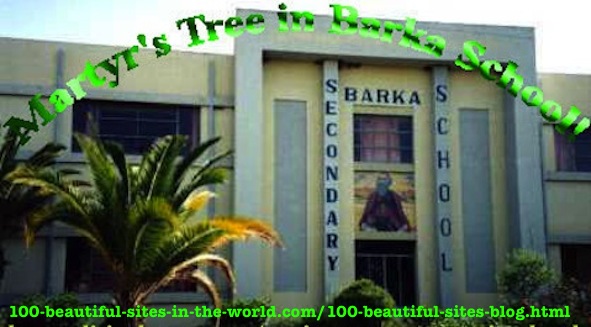 Archive of Truth in Exile Constructs a Social Ecosystem: One of the Eritrean Martyrs' Trees at Barka Secondary School... a palm tree chosen to honor the martyrs was planted after my personal visit to the school and a conversation with the director about my national and environmental plans. From moments like this, the ecosystem begins to take shape: one tree, one dialogue, one act of civic intention at a time.
Archive of Truth in Exile Constructs a Social Ecosystem: Dynamics - Ecology
HOA Climate Change Requires Governments Change!
For the HOA Climate Change, which requires governments change, the masses should do the climate math. How? Get my mind free of charge. You'll never regret.
Climate Change Should Lead to Classic Systems Change!
Climate Change is product of the ruling elites of classic political parties and their classic systems. That requires changing classic systems to masses systems.
What's HOA's Common Goal? How It Solves Your Global Disaster?
HOA's Common Goal helps you realize that the saying "that is the way it is" & the "obvious" are manipulated politically to accept the failure of your government.
Climate Justice Must Be Done by the Masses, Not by Calling Governments
Climate Justice should be done by world masses, not by calling governments to do so. Governments will not put themselves into trials for climate, or anything.
Environmental Scene's 2 Dangerous Characteristics with Health Effects!
Environmental Scene has two characteristics, the announced & hidden scenes. Both foretell of dangers that are intolerable to humans and intolerable to the Earth.

Archive of Truth in Exile Constructs a Social Ecosystem: Dynamics - Environment
Sudanese Martyr's Day to Make Your Revolutionary Day!
The Sudanese Martyr's Day is a day created by journalist Khalid Mohammed Osman every month, every year to celebrate a Sudanese martyr.
Sudanese Martyr's Actions to Celebrate Martyr's Anniversaries & Revolt
The Sudanese Martyr’s Actions are planned to set you free by participating in martyrs’ anniversaries, and becoming organizer to defeat the totalitarian regime.
5,000,000 Martyr’s Trees Enhance Global Environment!
Khalid Osman's Eritrean Martyr’s Tree invention accomplished planting of 5,000.000 Eritrean martyrs trees & cleaned environment from chemical weapons & mines.
Environmental Scene's 2 Dangerous Characteristics with Health Effects!
Environmental Scene has two characteristics, the announced & hidden scenes. Both foretell of dangers that are intolerable to humans and intolerable to the Earth.
Archive of Truth in Exile Constructs a Social Ecosystem: Dynamics - First Impulse
Archive of Truth in Exile Creates a Social Infrastructure!
Archive of Truth in Exile Creates a Social Infrastructure: Exploring how testimony, human rights violations & Substack's episodic posts form a living social ecosystem that resists.
Archive of Truth in Exile Crafts a Social Architecture!
Archive of Truth in Exile Crafts a Social Architecture:
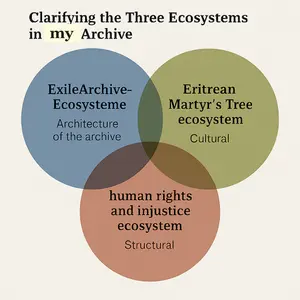
Archive of Truth in Exile Builds 3 Ecosystems! For Civic Movements!
Archive of Truth in Exile Builds 3 Ecosystems for civic resistance movements: Exile Archive Ecosystem, Eritrean Martyr's Tree's Ecosystem & Human Rights & Injustice Ecosystem.
Archive of Truth in Exile Constructs a Social Ecosystem: Dynamics - First Pulse
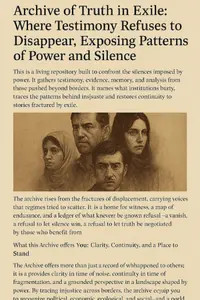
Archive of Truth in Exile: A Living Record of Power and Witness!
The Archive of Truth in Exile: Mapping silence, power, and survival. Testimony against erasure. Making an archive a living witness for you to claim justice.
Archive of Truth in Exile - Testimony Matters!
Archive of Truth in Exile - Testimony Matters: A foundational document on witness, erasure, and the moral architecture guiding the entire archive & raising societies.

Archive of Truth in Exile Constructs a Social Ecosystem: Dynamics Hub
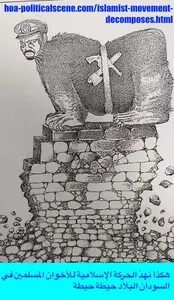
Islamist Movement Decomposes. Factual Facts of the Islamist Movement!
Islamist Movement Decomposes. This is clear to every modern and civilized mind. However, one question remains. Why this so called Islamic Movement is still controlling in some areas?
Conventional Narratives Hub Coverage From History to the Present!
Conventional Narratives Hub covers all narratives historically from the past to the present, whether they are economical, environmental, political, or social.
The Revolution I Would Not Sell!
The Revolution I Would Not Sell is a continuation to the unwritten system I have that proved to be working right! This system achieved planting 5 million trees to spark development.
Ink Between Borders - Exile by Principles: Peace Unheard!
Ink Between Borders - Exile by Principles: Peace Unheard! An urgent reflection on exile, unrecognized peace & moral resistance in post-conflict narratives.
Has International Terrorism Disappeared?
Has International Terrorism Disappeared? A political project like this has many phases. It is likely when the first phase has been done, we see the 2nd, the 3rd, etc...

Archive of Truth in Exile Constructs a Social Ecosystem: Dynamics Narratives Hub
The Cold War Era: A Battle of Ideologies and Influence!
The Cold War Era: A Battle of Ideologies and Influence! In my opinion, the world was better and more stable than today's world. What do you think?
The Eastern Europe Socialist Bloc Fragmentation!
The Eastern Europe Socialist Bloc Fragmentation costs effectively until today. Are there any real causes of the deterioration of great counties in the world?
Conventional Narratives Are Always Wrong!
Why Am I Saying Conventional Narratives Are Always Wrong? Explore the connection of these narratives from colonial era until this era and know what to do!
Established Frameworks Invisible Forces Shaping Perception!
Established Frameworks Invisible Forces Shape Perception! The insights help you escape narratives that control your life & help others build a better world.
How Dominant Perspectives Shape Our World?
How Dominant Perspectives Shape Our World? Explore to know what to accept and what to refuse.

Archive of Truth in Exile Constructs a Social Ecosystem: Injustice to Challenge
Are Odense Municipality, CIVICA Housing Company & the Police Corrupt?
Are Odense Municipality, CIVICA Housing Company & the Police Corrupt? More than seventy years of foreigners presence in Denmark has corrupted Denmark.
What the Heck are Human Rights Organizations and the UNHCR Doing?
What the Heck are Human Rights Organizations and the UNHCR Doing is a serious question these organisations should think about before losing any credibility and transparency.
In Denmark They Violate Human Rights for Money
In Denmark They Violate Human Rights for Money! This is a real time report you can call real life story that expose privacy and thus human rights violations in Denmark.
Is the Law Paralyzed Resulting in Injustice in Denmark?
Is the Law Paralyzed Resulting in Injustice in Denmark? This question exposes how some people from a specific culture can make things worse, when they are employed in the police forces.


Archive of Truth in Exile Constructs a Social Ecosystem: Injustice to Confront
Political News: No Political Borders Should Exist Between Humans!
Political News to dynamically minimize the political borders between humans. The mind is ours and you learn from a century of persistence.
Refugees in the Long Run to Survive!
Hot times refugees will emerge whenever there's crisis on Earth. What should we do for them? Best answer: Give them new homes & warm feelings. Unfortunately...
Refugees in Denmark Lacking the Bright Future!
The situations of refugees in Denmark impose the question why Denmark is tough with the UN Convention political refugees? This is the toughest question I have been asked!


Archive of Truth in Exile Constructs a Social Ecosystem: Injustice to Criticise
Politik i Horn af Afrika!
Politiken er mit arbejde! Jeg havde praktiseret politik som journalist i Horn af Afrika og Mellemøsten områder, over tredive år.
What Dogmatism Actually Means?
Is dogmatism passive? Intelligentsias don't consider dogmatism as an active habit, so how it works to limit the vision of some elites and how to get rid of it?

Archive of Truth in Exile Constructs a Social Ecosystem: Pain Travels With Us
Substack Exile Archive Presents Fragments of Resistance!
Substack Exile Archive Presents Fragments of Resistance... poetic testimony, legal critique, and public witness from the margins of exile and defiance.
Substack Exile Archive - Ethics of Proximity - Shadow Beneath State!
Substack Exile Archive - Ethics of Proximity - Shadow Beneath State explores how some authorities manipulate and break the system of fairness and justice.
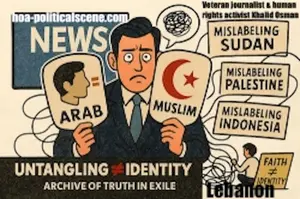
Arab - Muslim: Untangling Faith Identity!
Arab - Muslim: Untangling Faith Identity!


What Do You Think of "Archive of Truth in Exile Constructs a Social Ecosystem"?
Within this evolving ecosystem, each idea, memory, and act of witness becomes part of a larger structure... one that grows through attention, interpretation, and the quiet work of returning to what has been set in motion. The page offers a space where connections can surface, where patterns reveal themselves, and where the architecture of truth begins to show its deeper logic.
As the ecosystem expands, new insights, questions, and resonances naturally find their place within it. The work invites a moment of pause, a chance to sense how its strands interact, and how each layer contributes to the living structure it continues to build.
***** Make the Arcive of Truth in Exile your home and specially those infrastructure constructive pages including "Archive of Truth in Exile Constructs a Social Ecosystem":
***** Connect with the HOA Political Scene Network through the form below. Use the same form to comment and tell's what you think of "Archive of Truth in Exile Constructs a Social Ecosystem":
Have A Great Story About This Topic?
Do you have a great story about this? Share it!
Concerned about Conflicts Fact that Never Been Disclosed?
Get Horn Africa's Political Tragedy.
Recent Articles


-
HOA's Interval with Wisdom Nuggets of Inspiring Ethical Proverbs!
Sep 09, 26 04:59 AM
 HOA's Interval with Wisdom Nuggets of Inspiring Ethical Proverbs! You can see your ethics & the ethics of the surroundings clearly to develop & enhance your own.
 -
Intelligentsia 61 from Danish Injustice to American War Abortion of
Aug 29, 26 11:14 AM
 Intelligentsia 61 from Danish Injustice to American War Abortion of Iranian Revolution and Media Stupidity, world people fall into the trap of manipulation.
 -
When, Why and How the European Paradise Became Hell on Earth?
Aug 23, 26 10:20 AM
 When, Why and How the European Paradise Became Hell on Earth? This one in the dynamics will make your mind spin and reflect with clarity to address this matter.
Some Support is Appreciated so Much!
When I get a new information, or a good read, my conscience tells me to be obliged to whom has added a drop of knowledge with some values in my life by doing some good deeds to him. Some links here get me a little power to support some people in need, indeed, by paying my subscription to international human organizations I am part of their generous good deeds. Like this at Awassa.
A Friend in Need is A Friend Indeed!
How many times have you fallen like a mountain, because you were great with your inspirations, guidance and professional teaching and later on found some people you made professional drawn in luxuries and never cared about you?
A hand up is better than a hand down. Share a link of a page you liked in great sites, but please not FACEBOOK. I am a man of principles.
A Man is Known by the Company he Keeps!
True, don't you think so? I can tell you stories and stories about that. Can you tell me one in details with the original cultures of the world it refers to? Take the cultural section by a huge and write that in the comments form.
Healthy Citizens are the Greatest Asset any Country can have!
It's true. But, he didn't know what ill governance can do for healthy citizens, or how ill monarchies can bring healthy citizens into miseries, or why great powers play by the fates of so many healthy citizens in the world.
Know any similar situations where healthy citizens are broken by the ruling elites in any country? Bring that into readers' attention through the comments form at Are You Intellectual?
Global Dynamics to Make Everyone Intellectual
Look for the top 100 Google most searched terms globally in 2021. You will not find any single thing that any person looks for and wants to know about, or use in daily life, such as food, health, education, cinema, tv, news, developing qualities and qualifications, playing, traveling, and even what causes Coronavirus and other pandemics, which are real threats to all people lives etc... You will find only search terms used for top social media, Youtube, search engines and Amazon. Political illiteracy is what matters to me to educate. See Global Dynamics & signup for the newsletter.
Did you get any of my books from Apple Books?
Click here to tell me & get some free books. Fill the form.
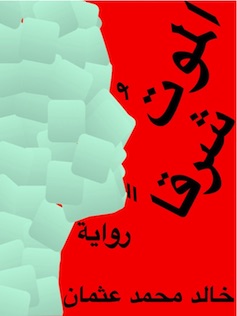
رواية "الموتُ شرقاً" تكشف لك سرّ الموت الشرقي التراجيدي المستمر للإنسان
احصل علي الرواية الآن واكتشف إنهيار القواسم المشتركة، واستلهم إبداعا يشبه الأسطورة في النص الروائي
"Follow", "like", "tweet", or "pin" the pictures to express your love! Thanks
TweetHorn Africa's Political Tragedy

Love in the Internet Time on Apple Books

Rising of the Phoenix Poetry on Apple Books

Free Poetry Picture Book
Free poetry picture book on Apple Books. You can use the images on public places for your customers to enjoy, while taking coffee.

The French & Spanish Versions
You can work the French versions and the Spanish versions of the two books above with me on, one on one bases. Contact Us.
HOAs Political Poetry Imaged
I'll be thankful, if you get one of my books.
My Books!