Archive of Truth in Exile Crafts a Social Architecture!
Archive of Truth in Exile Crafts a Social Architecture: this describes a structure shaped by two intertwined dynamic forces:
- A living local environment and national practices to sustain the environment and maintain national values.
- A living social ecosystem the local environmental and national practices have built that resists erasure, injustice, neglect and social crises, and connects political analysis with lived experience.
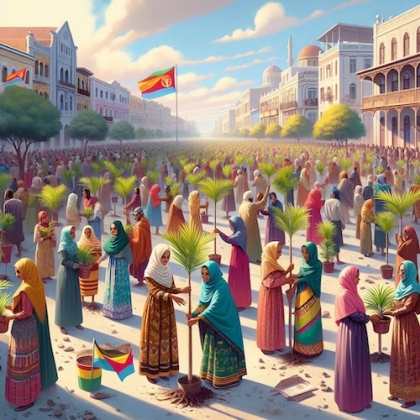 Archive of Truth in Exile Crafts a Social Architecture: How an environmental and national experiences I carried out in Eritrea after its independence in 1991 have created a social architecture that you can apply in your society and lead it toward progress? My environmental and national project, the Eritrean Martyr's Tree has been born with its infrastructure, architecture and ecosystem for global prosperity too. This is one of the first and most effective Global Dynamics I have created. Explore the dynamics below the main content. Forward the link of the page to your friends, followers and post it everywhere. Let your heart beat with it worldwide.
The architecture of this archive is not a metaphor. It is a deliberate structural design... a framework that sequences testimony, organizes memory, and guides readers through a landscape shaped by exile, silence, and procedural harm.
Its scaffolding is built from clarity: numbered pathways, layered pages, semantic headings, and a navigational rhythm that allows readers to move from the surface of a story into its deeper strata. Every section is positioned with intention, so the archive remains coherent even as it grows, adapts, and absorbs new witness.
This architectural logic is practical and ethical at once. It ensures that no testimony stands alone, that no page becomes an island, and that readers can trace how patterns repeat across borders and institutions.
Structure becomes a form of protection... a way to hold memory without distortion, to preserve continuity where official systems have fractured it, and to give readers a stable route through unstable histories.
At the same time, this architecture is not isolated from the cultural worlds that shaped it. It draws strength from the symbolic architecture of the Eritrean Martyr's Tree... a structure rooted in contested memory, ritual, and the politics of remembrance.
Where the archive's architecture provides clarity and sequence, the Martyr's Tree provides depth and cultural resonance. Together, they show how testimony can be both structurally organized and culturally grounded, forming a bridge between lived memory and the systems that seek to erase it.
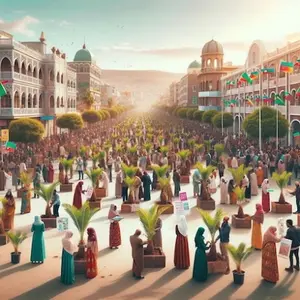
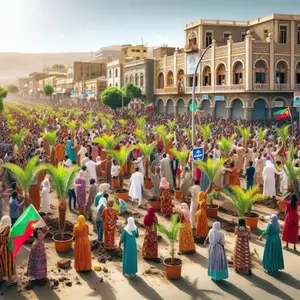
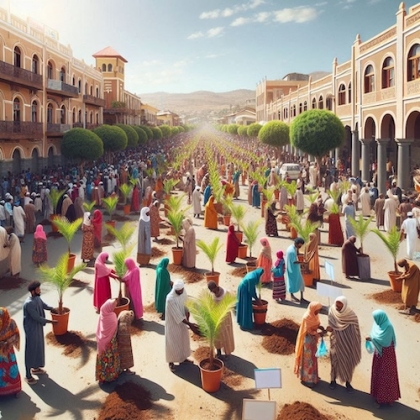 Archive of Truth in Exile Crafts a Social Architecture: Illustrating Eritrean people with palm trees to plant for their martyrs in the Eritrean Martyrs Day. During the architecture planning for the Martyr's Tree I created, I had the vision of how such national and environmental activity can be adapted anywhere else to create a social movement and develop world societies from within their national values, through a dynamic shift to the NGOs motto, which says "Think Globally, Act Locally". I shipped that motto by my motto "Think Locally, Act Globally". It is all about the right vision.
Architecture of the Eritrean Martyr's Tree!
The architecture of the Eritrean Martyr's Tree is not a physical design but a cultural structure... a ritual blueprint shaped by memory, loss, and contested belonging. Its form emerges from the way communities gather, name, remember, and negotiate the meaning of sacrifice. Each branch carries a story, each leaf a name, and each root a history that refuses erasure.
The architecture is therefore both symbolic and functional: it organizes remembrance, distributes emotional weight, and anchors a dispersed people in a shared moral landscape.
This architecture is layered. At its core lies the ritual act of naming... a practice that transforms individual loss into collective memory. Around it grows the communal canopy: gatherings, songs, silences, and the annual rhythms of remembrance that give the Tree its living shape.
And beneath it runs a contested root system, where state narratives, diaspora memory, and personal grief collide. The Martyr's Tree is never neutral; its architecture is a site of struggle over who is remembered, how, and by whom.
Yet despite these tensions, the Tree endures as a cultural structure that holds communities together across borders. Its architecture is adaptive: it survives exile, reinvents itself in new geographies, and absorbs the shifting politics of remembrance. It is a design that moves with people, not one fixed in stone.
In this way, the architecture of the Martyr's Tree mirrors and quietly informs the architecture of the archive. Where the Tree organizes memory through ritual and symbol, the archive organizes memory through structure and sequence. Both are systems of continuity. Both resist erasure. And both reveal how a dispersed community builds meaning, even when the ground beneath it is unstable.
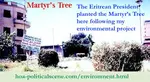
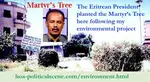
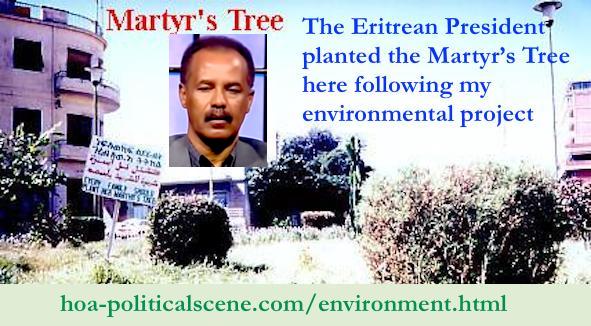 Archive of Truth in Exile Crafts a Social Architecture: The image captures the planting of an Eritrean Martyrs' Tree by President Isaias Afwerki at the traffic circle on Martyrs' Street, near the Nyala Hotel, during one of my environmental projects. The ceremony took place in the presence of diplomatic representatives and the Mayor of Asmara Sebhat Ephrem and was documented by the Ministry of Social Affairs, then led by Minister Amna Nur Hussein. Behind this moment lies a story of collective preparation and urgency. I had coordinated with the Eritrean Teachers Association to produce the banners for the event. On the day itself, I carried one of the heavy metal banners on my shoulders and ran from the Association Club all the way to the planting site. Just as the President finished placing the tree into the ground, I arrived and positioned the banner beside it, perfectly timed, almost as if the moment had been choreographed by fate.
How the Architecture of the Eritrean Martyr’s Tree Can Benefit Other Societies?
The architecture of the Eritrean Martyr's Tree is rooted in a specific history, yet its structural logic carries lessons far beyond its cultural origin. At its core, the Tree is a system for organizing memory: a design that transforms individual loss into collective continuity, and contested narratives into shared civic responsibility.
This architecture can serve as a model for other societies seeking to rebuild trust, confront historical harm, or reconnect communities fractured by violence, displacement, or institutional failure.
What makes the Martyr's Tree transferable is not its symbolism, but its systemic rhythm... the way it integrates infrastructure, architecture, and ecosystem building into a coherent whole.
- Its infrastructure is moral and communal: a commitment to naming, remembering, and refusing erasure.
- Its architecture is ritual and structural: a design that sequences remembrance through gatherings, stories, and the annual cadence of collective memory and...
- Its ecosystem is adaptive: a living network that survives across borders, reshapes itself in exile, and absorbs new forms of witness without losing its core identity.
Other societies can draw from this rhythm without copying the Tree itself. They can adopt its principles:
- Memory as a shared utility, not a private burden.
- Ritual as architecture, giving shape to grief and continuity.
- Community-led remembrance, independent of state narratives.
- Adaptive ecosystems, capable of surviving displacement and political rupture.
- Structures that honour the dead by empowering the living.
In places where institutions have failed to hold power accountable, the architecture of the Martyr's Tree offers a blueprint for rebuilding civic memory from the ground up. It shows how communities can create their own infrastructures of remembrance, their own architectures of continuity, and their own ecosystems of resistance... systems that endure even when official histories collapse.
By translating the Tree's systemic rhythm into their own cultural forms, other societies can cultivate structures that protect memory, strengthen community, and resist the erasures that accompany injustice, or any of the problems we have in the world.
The Martyr's Tree becomes not a symbol to be replicated, but a method... a way of designing memory that is both rooted and portable, specific and universal, cultural and civic at once.
How International Societies Can Implement the Same Successful Practices?
A practical, step‑by‑step framework based on infrastructure ➡ architecture ➡ ecosystem building:
- 1. Build the Moral Infrastructure First:
Before any structure or ritual can take shape, societies need a shared moral foundation.
Practical steps:
Acknowledge harm publicly:
Communities must name the injustices they carry... colonial, political, institutional, or communal.
Create a shared commitment to remembrance:
Not as nostalgia, but as civic responsibility.
Identify the dispersed or silenced voices:
Who has been erased, ignored, or misrepresented.
Establish a principle of continuity:
Memory is not episodic; it is a public utility.
Why this matters?
Without moral infrastructure, any architecture collapses into symbolism without substance.
- 2. Design the Architecture of Remembrance:
This is where the Martyr’s Tree becomes a transferable model.
Practical steps:
Create a naming structure:
A way to honor individuals or events that form the backbone of collective memory.
Develop rituals that repeat:
Annual, monthly, or situational practices that give memory a rhythm.
Build a navigational logic:
Clear pathways that help people move from individual stories to collective understanding.
Ensure accessibility:
The architecture must be open to all... not controlled by elites or institutions.
Why this matters?
Architecture gives memory shape, sequence, and stability.
- 3. Cultivate a Living Ecosystem Around the Structure:
An ecosystem ensures the architecture doesn't become static.
Practical steps:
Invite multiple forms of witness:
Testimony, art, music, legal documents, oral histories.
Allow the system to adapt across borders:
Diaspora communities should be able to carry the structure with them.
Encourage community-led contributions:
The ecosystem grows through participation, not central control.
Integrate digital and physical spaces:
Memory must circulate where people live... online and offline.
Why this matters?
An ecosystem keeps memory alive, mobile, and resistant to erasure.
- 4. Protect the System from Political Capture:
The Martyr's Tree teaches that memory is always contested.
Practical steps:
Create independent stewardship bodies.
Community-led, not state-controlled.
Document the rules of remembrance:
Transparency prevents manipulation.
Build safeguards against selective memory:
No group should monopolize the narrative.
Ensure intergenerational transmission:
Young people must inherit the structure without distortion.
Why this matters?
Memory that is captured becomes propaganda; memory that is protected becomes civic strength.
- 5. Translate the Model into Local Cultural Forms:
Societies should not copy the Martyr’s Tree literally: they should adopt its logic.
Practical steps:
Identify local symbols of continuity.
Trees, rivers, stones, songs, communal spaces.
Adapt rituals to local rhythms:
What matters is repetition and meaning, not replication.
Use local languages and metaphors:
Memory must feel native, not imported.
Let communities define the emotional tone:
Some cultures lean toward silence, others toward ceremony.
Why this matters?
A model only survives when it feels culturally rooted.
- 6. Connect Memory to Civic Action:
The Martyr's Tree is not only symbolic... it is civic.
Practical steps:
Link remembrance to accountability.
Truth-telling, documentation, legal advocacy.
Use the structure to expose patterns:
How harm repeats across institutions and borders.
Turn memory into public education:
Schools, community centers, digital archives.
Create pathways from grief to agency:
Memory should empower, not paralyze.
Why this matters?
A society that remembers responsibly becomes harder to manipulate.
- 7. Ensure the System Can Travel Across Borders:
Just like the Eritrean diaspora carried the Tree, other societies need portable memory systems.
Practical steps:
Digitize the architecture:
So it survives displacement, migration, or political rupture.
Allow communities abroad to adapt the rituals:
Memory must breathe in new geographies.
Build transnational networks of remembrance:
Harm often crosses borders; memory should too.
Use shared hashtags or symbolic anchors:
To connect dispersed communities into one ecosystem.
Why this matters?
A memory system that cannot travel will not survive crisis.
The Core Insight:
The architecture of the Eritrean Martyr's Tree is not a cultural artifact... it is a method.
A way of designing memory that is:
- Structured.
- Adaptive.
- Communal.
- Resistant.
- Portable.
- Ethically grounded.
Any society facing injustice, fragmentation, or historical silence can adopt this method... not by copying the Tree, but by replicating its systemic rhythm.
How Societies Can Use the Methods of the Eritrean Martyr's Tree to Craft Social ARCHITECTURE for Any Civic Objective?
The Martyr's Tree is more than a memorial tradition or a memorial structure. It is a system for building shared meaning, a method that turns scattered experiences into continuity.
It is a civic responsibility. Its systemic rhythm can be applied to any societal objective... a rhythm that binds communities across borders: environmental stewardship, youth empowerment, public health, anti‑corruption work, community safety, cultural preservation, or democratic participation.
Its success in the Eritrean example comes from the way it integrates infrastructure, architecture, and ecosystem building into one coherent civic practice. Other societies can adopt this method... not by copying the Tree itself, but by applying its logic to any collective objective they want to strengthen.
How to Build a Civic Ethos?: A Practical Method Inspired by Eritrea's Martyr's Tree
The Eritrean Martyr's Tree is more than a cultural symbol. It functions as a repeatable method for building civic ethos: shared responsibility, shared memory, and shared action that can endure pressure, change, and even displacement.
What makes the Tree powerful is not that people gather around it, but how the system works: it begins with a moral agreement, becomes visible through structure and ritual, grows through community participation, stays protected from capture, adapts to local culture, produces real-world outcomes, and can travel across borders.
Below is a practical, step-by-step framework any society, or community organization can apply to strengthen cohesion, confront injustice, and build continuity around a shared objective.
1) Start With Moral Infrastructure
Every durable civic initiative begins with an ethical foundation people broadly accept. Before you build programs, campaigns, or institutions, define what your community stands for.
Practical steps:
- Define the core value you want to protect or cultivate (clean water, justice, literacy, dignity, environmental care, community safety, youth empowerment).
- Name the harm or gap that makes this value urgent (corruption, abuse, discrimination, trafficking, economic hardship, neglect).
- Establish a shared commitment that the value belongs to everyone—not one party, group, or class.
- Center the voices most affected by the issue by identifying underserved or silenced communities and making their perspective part of the foundation.
Why this works?
Ethos grows from shared moral ground, not slogans. Without collective agreement on "what matters," any structure you build becomes fragile or performative.
2) Build Clear Architecture Around the Value:
Values stay abstract until they take shape in public life. Architecture gives a value rhythm, visibility, and continuity, so people can recognize it, join it, and pass it on.
Practical steps:
- Create a naming system: identify the people, events, or milestones that embody the value (community elders, youth leaders, environmental defenders, local heroes).
- Design recurring rituals: monthly gatherings, annual days of action, weekly community circles, seasonal ceremonies.
- Build clear pathways for participation: create a simple journey from awareness ➡ involvement ➡ contribution.
- Make the structure public and accessible: community boards, digital platforms, symbolic markers, shared dashboards, or public anchors.
Why this works?
Architecture turns an abstract idea into a living structure people can enter, navigate, and contribute to.
3) Grow a Living Ecosystem Around the Structure:
A strong civic ethos doesn’t depend on one leader or one organization. It becomes an ecosystem... multiple contributors, many entry points, and the ability to adapt without breaking.
Practical steps:
- Invite multiple forms of contribution: stories, art, data collection, volunteering, oral histories, mentorship, testimony.
- Allow adaptation across communities so rituals and participation fit different contexts.
- Connect institutions and grassroots groups: schools, faith groups, local councils, activists, elders, youth organizations.
- Use digital tools to extend reach and continuity: shared archives, community platforms, hashtags, online calendars.
Why this works?
The Tree survives because it functions like a living network, not a fixed monument.
4) Protect the Structure From Capture or Distortion:
Any successful civic structure attracts attention and pressure. Without safeguards, it can be monopolized, politicized, or turned into a tool of control.
Practical steps:
- Create independent stewardship groups: rotating committees, youth boards, community councils.
- Document transparent rules of participation so the process cannot be manipulated.
- Ensure representation across communities so no single group dominates the narrative.
- Build intergenerational continuity by deliberately passing roles, knowledge, and rituals to younger members.
Why this works?
Endurance requires protection. A civic ethos lasts when communities prevent it from being weaponized or owned.
5) Translate the Method Into Local Cultural Forms:
The goal is not to copy the Martyr's Tree as a symbol, but to apply its logic using what already carries emotional meaning in your community.
Practical steps:
- Identify local symbols: rivers, mountains, gardens, songs, community spaces, local memorials.
- Use local languages and metaphors so the value feels native, not imported.
- Adapt the rhythm to local calendars and traditions: what matters is repetition and meaning.
- Let communities shape the emotional tone: some cultures prefer ceremony; others prefer quiet, consistent service.
Why this works?
Ethos grows when people see themselves reflected in the structure.
6) Link the Structure to Real Civic Action
A civic ethos becomes truly powerful when it produces agency. Ritual alone is not enough; it must lead to measurable responsibility and change.
Practical steps:
Tie rituals to tangible outcomes:
- Clean-water days ➡ water testing and reporting
- Remembrance rituals ➡ youth leadership programs
- Anti-corruption commitments ➡ transparency audits and public scorecards
- Use the structure to expose repeating patterns of harm or neglect across institutions.
- Turn participation into empowerment by giving people roles (organizers, stewards, mentors, data keepers), not just attendance.
Why this works?
The Martyr's Tree turns memory into responsibility. Ethos becomes real when it changes what people can do.
7) Ensure the System Can Travel Across Borders:
A resilient civic ethos doesn’t disappear when people move. If your community faces migration, crisis, or displacement, the structure must be portable.
Practical steps:
- Digitize the structure: archives, guides, calendars, stories, and participation tools.
- Enable diaspora and migrant communities to adapt rituals without needing permission from a central authority.
- Build transnational networks: shared events, shared data, shared storytelling.
- Use simple symbolic anchors that unify dispersed groups (icons, phrases, hashtags, recurring dates).
Why this works?
A civic ethos that can travel becomes a durable identity, not a fragile local project.
The Core Insight:
The Eritrean Martyr’s Tree shows a repeatable method for building civic ethos:
- Start with moral infrastructure.
- Build clear architecture.
- Grow a living ecosystem.
- Protect the structure.
- Translate it into local forms.
- Link it to action.
- Make it portable.
Used well, this framework can help any community strengthen unity, confront injustice, and build long-term continuity around shared goals—from environmental protection to democratic renewal.
This Is Not Merely About "Archive of Truth in Exile Crafts a Social Architecture"!
"It is a social revolution. It defines the revolution as infrastructure, architecture and ecosystem. It is a revolution of positive mind thinking and reverts the violence in the revolution into a peaceful revolution. A revolution never needs violence to correct wrong doing, or solve crises. It requires a futuristic intelligent mind to infiltrate the infrastructure of a society and build upon it a social movement toward progress." Veteran human rights and environmental activist and journalist Khalid Mohammed Osman.
Archive of Truth in Exile Crafts a Social Architecture: Dynamics - Ecology
HOA Climate Change Requires Governments Change!
For the HOA Climate Change, which requires governments change, the masses should do the climate math. How? Get my mind free of charge. You'll never regret.
Climate Change Should Lead to Classic Systems Change!
Climate Change is product of the ruling elites of classic political parties and their classic systems. That requires changing classic systems to masses systems.
What's HOA's Common Goal? How It Solves Your Global Disaster?
HOA's Common Goal helps you realize that the saying "that is the way it is" & the "obvious" are manipulated politically to accept the failure of your government.
Climate Justice Must Be Done by the Masses, Not by Calling Governments
Climate Justice should be done by world masses, not by calling governments to do so. Governments will not put themselves into trials for climate, or anything.
Environmental Scene's 2 Dangerous Characteristics with Health Effects!
Environmental Scene has two characteristics, the announced & hidden scenes. Both foretell of dangers that are intolerable to humans and intolerable to the Earth.


Archive of Truth in Exile Crafts a Social Architecture: Dynamics - Environment
Sudanese Martyr's Day to Make Your Revolutionary Day!
The Sudanese Martyr's Day is a day created by journalist Khalid Mohammed Osman every month, every year to celebrate a Sudanese martyr.
Sudanese Martyr's Actions to Celebrate Martyr's Anniversaries & Revolt
The Sudanese Martyr’s Actions are planned to set you free by participating in martyrs’ anniversaries, and becoming organizer to defeat the totalitarian regime.
5,000,000 Martyr’s Trees Enhance Global Environment!
Khalid Osman's Eritrean Martyr’s Tree invention accomplished planting of 5,000.000 Eritrean martyrs trees & cleaned environment from chemical weapons & mines.
Environmental Scene's 2 Dangerous Characteristics with Health Effects!
Environmental Scene has two characteristics, the announced & hidden scenes. Both foretell of dangers that are intolerable to humans and intolerable to the Earth.

Archive of Truth in Exile Crafts a Social Architecture: Dynamics - First Impulse
Archive of Truth in Exile Constructs a Social Ecosystem!
The Archive of Truth in Exile Constructs a Social Ecosystem: How testimony, human rights violations, injustice & Substack's episodic posts form a living social ecosystem.
Archive of Truth in Exile Creates a Social Infrastructure!
Archive of Truth in Exile Creates a Social Infrastructure: Exploring how testimony, human rights violations & Substack's episodic posts form a living social ecosystem that resists.
Archive of Truth in Exile Builds 3 Ecosystems! For Civic Movements!
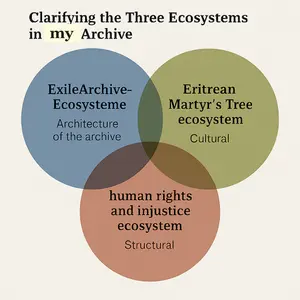
Archive of Truth in Exile Builds 3 Ecosystems for civic resistance movements: Exile Archive Ecosystem, Eritrean Martyr's Tree's Ecosystem & Human Rights & Injustice Ecosystem.
Archive of Truth in Exile Crafts a Social Architecture: Dynamics - First Pulse
Archive of Truth in Exile: A Living Record of Power and Witness!
The Archive of Truth in Exile: Mapping silence, power, and survival. Testimony against erasure. Making an archive a living witness for you to claim justice.
Archive of Truth in Exile - Testimony Matters!
Archive of Truth in Exile - Testimony Matters: A foundational document on witness, erasure, and the moral architecture guiding the entire archive & raising societies.
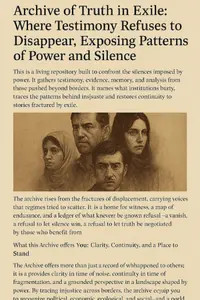

Archive of Truth in Exile Crafts a Social Architecture: Dynamics Hub
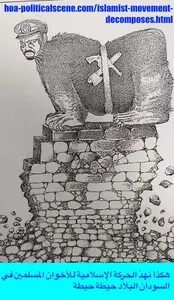
Islamist Movement Decomposes. Factual Facts of the Islamist Movement!
Islamist Movement Decomposes. This is clear to every modern and civilized mind. However, one question remains. Why this so called Islamic Movement is still controlling in some areas?
Conventional Narratives Hub Coverage From History to the Present!
Conventional Narratives Hub covers all narratives historically from the past to the present, whether they are economical, environmental, political, or social.
The Revolution I Would Not Sell!
The Revolution I Would Not Sell is a continuation to the unwritten system I have that proved to be working right! This system achieved planting 5 million trees to spark development.
Ink Between Borders - Exile by Principles: Peace Unheard!
Ink Between Borders - Exile by Principles: Peace Unheard! An urgent reflection on exile, unrecognized peace & moral resistance in post-conflict narratives.
Has International Terrorism Disappeared?
Has International Terrorism Disappeared? A political project like this has many phases. It is likely when the first phase has been done, we see the 2nd, the 3rd, etc...


Archive of Truth in Exile Crafts a Social Architecture: Dynamics Narratives Hub
The Cold War Era: A Battle of Ideologies and Influence!
The Cold War Era: A Battle of Ideologies and Influence! In my opinion, the world was better and more stable than today's world. What do you think?
The Eastern Europe Socialist Bloc Fragmentation!
The Eastern Europe Socialist Bloc Fragmentation costs effectively until today. Are there any real causes of the deterioration of great counties in the world?
Conventional Narratives Are Always Wrong!
Why Am I Saying Conventional Narratives Are Always Wrong? Explore the connection of these narratives from colonial era until this era and know what to do!
Established Frameworks Invisible Forces Shaping Perception!
Established Frameworks Invisible Forces Shape Perception! The insights help you escape narratives that control your life & help others build a better world.
How Dominant Perspectives Shape Our World?
How Dominant Perspectives Shape Our World? Explore to know what to accept and what to refuse.


Archive of Truth in Exile Crafts a Social Architecture: Injustice to Challenge
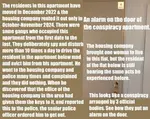
Are Odense Municipality, CIVICA Housing Company & the Police Corrupt?
Are Odense Municipality, CIVICA Housing Company & the Police Corrupt? More than seventy years of foreigners presence in Denmark has corrupted Denmark.
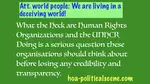
What the Heck are Human Rights Organizations and the UNHCR Doing?
What the Heck are Human Rights Organizations and the UNHCR Doing is a serious question these organisations should think about before losing any credibility and transparency.
In Denmark They Violate Human Rights for Money
In Denmark They Violate Human Rights for Money! This is a real time report you can call real life story that expose privacy and thus human rights violations in Denmark.
Is the Law Paralyzed Resulting in Injustice in Denmark?
Is the Law Paralyzed Resulting in Injustice in Denmark? This question exposes how some people from a specific culture can make things worse, when they are employed in the police forces.

Archive of Truth in Exile Crafts a Social Architecture: Injustice to Confront
Political News: No Political Borders Should Exist Between Humans!
Political News to dynamically minimize the political borders between humans. The mind is ours and you learn from a century of persistence.
Refugees in the Long Run to Survive!
Hot times refugees will emerge whenever there's crisis on Earth. What should we do for them? Best answer: Give them new homes & warm feelings. Unfortunately...
Refugees in Denmark Lacking the Bright Future!
The situations of refugees in Denmark impose the question why Denmark is tough with the UN Convention political refugees? This is the toughest question I have been asked!


Archive of Truth in Exile Crafts a Social Architecture: Injustice to Criticise
Politik i Horn af Afrika!
Politiken er mit arbejde! Jeg havde praktiseret politik som journalist i Horn af Afrika og Mellemøsten områder, over tredive år.
What Dogmatism Actually Means?
Is dogmatism passive? Intelligentsias don't consider dogmatism as an active habit, so how it works to limit the vision of some elites and how to get rid of it?

Archive of Truth in Exile Crafts a Social Architecture: Pain Travels With Us
Substack Exile Archive Presents Fragments of Resistance!
Substack Exile Archive Presents Fragments of Resistance... poetic testimony, legal critique, and public witness from the margins of exile and defiance.
Substack Exile Archive - Ethics of Proximity - Shadow Beneath State!
Substack Exile Archive - Ethics of Proximity - Shadow Beneath State explores how some authorities manipulate and break the system of fairness and justice.
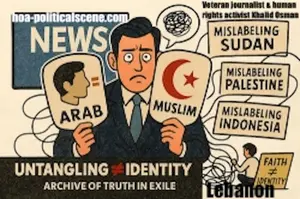
Arab - Muslim: Untangling Faith Identity!
Arab - Muslim: Untangling Faith Identity!


What Do You Think of "Archive of Truth in Exile Crafts a Social Architecture"?
Archive of Truth in Exile Crafts a Social Architecture is meant to be lived with, not just read. If the ideas in it stirred something—recognition, resistance, friction, or a new line of thought—your voice can help shape the next layer of this evolving architecture.
Bring whatever the piece awakened in you: a question, a memory, a challenge, a thread you feel belongs in this wider tapestry. The archive grows stronger when its readers step into the space it opens.
If something in the work called out to you, follow that impulse and add your own strand to the structure.
Have A Great Story About This Topic?
Do you have a great story about this? Share it!
Concerned about Conflicts Fact that Never Been Disclosed?
Get Horn Africa's Political Tragedy.
Recent Articles


-
HOA's Interval with Wisdom Nuggets of Inspiring Ethical Proverbs!
Sep 09, 26 04:59 AM
 HOA's Interval with Wisdom Nuggets of Inspiring Ethical Proverbs! You can see your ethics & the ethics of the surroundings clearly to develop & enhance your own.
 -
Intelligentsia 61 from Danish Injustice to American War Abortion of
Aug 29, 26 11:14 AM
 Intelligentsia 61 from Danish Injustice to American War Abortion of Iranian Revolution and Media Stupidity, world people fall into the trap of manipulation.
 -
When, Why and How the European Paradise Became Hell on Earth?
Aug 23, 26 10:20 AM
 When, Why and How the European Paradise Became Hell on Earth? This one in the dynamics will make your mind spin and reflect with clarity to address this matter.
Some Support is Appreciated so Much!
When I get a new information, or a good read, my conscience tells me to be obliged to whom has added a drop of knowledge with some values in my life by doing some good deeds to him. Some links here get me a little power to support some people in need, indeed, by paying my subscription to international human organizations I am part of their generous good deeds. Like this at Awassa.
A Friend in Need is A Friend Indeed!
How many times have you fallen like a mountain, because you were great with your inspirations, guidance and professional teaching and later on found some people you made professional drawn in luxuries and never cared about you?
A hand up is better than a hand down. Share a link of a page you liked in great sites, but please not FACEBOOK. I am a man of principles.
A Man is Known by the Company he Keeps!
True, don't you think so? I can tell you stories and stories about that. Can you tell me one in details with the original cultures of the world it refers to? Take the cultural section by a huge and write that in the comments form.
Healthy Citizens are the Greatest Asset any Country can have!
It's true. But, he didn't know what ill governance can do for healthy citizens, or how ill monarchies can bring healthy citizens into miseries, or why great powers play by the fates of so many healthy citizens in the world.
Know any similar situations where healthy citizens are broken by the ruling elites in any country? Bring that into readers' attention through the comments form at Are You Intellectual?
Global Dynamics to Make Everyone Intellectual
Look for the top 100 Google most searched terms globally in 2021. You will not find any single thing that any person looks for and wants to know about, or use in daily life, such as food, health, education, cinema, tv, news, developing qualities and qualifications, playing, traveling, and even what causes Coronavirus and other pandemics, which are real threats to all people lives etc... You will find only search terms used for top social media, Youtube, search engines and Amazon. Political illiteracy is what matters to me to educate. See Global Dynamics & signup for the newsletter.
Did you get any of my books from Apple Books?
Click here to tell me & get some free books. Fill the form.
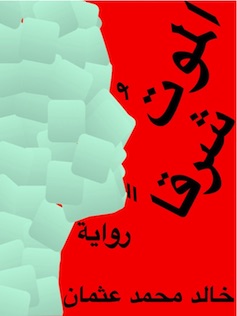
رواية "الموتُ شرقاً" تكشف لك سرّ الموت الشرقي التراجيدي المستمر للإنسان
احصل علي الرواية الآن واكتشف إنهيار القواسم المشتركة، واستلهم إبداعا يشبه الأسطورة في النص الروائي
"Follow", "like", "tweet", or "pin" the pictures to express your love! Thanks
TweetHorn Africa's Political Tragedy

Love in the Internet Time on Apple Books

Rising of the Phoenix Poetry on Apple Books

Free Poetry Picture Book
Free poetry picture book on Apple Books. You can use the images on public places for your customers to enjoy, while taking coffee.

The French & Spanish Versions
You can work the French versions and the Spanish versions of the two books above with me on, one on one bases. Contact Us.
HOAs Political Poetry Imaged
I'll be thankful, if you get one of my books.
My Books!